

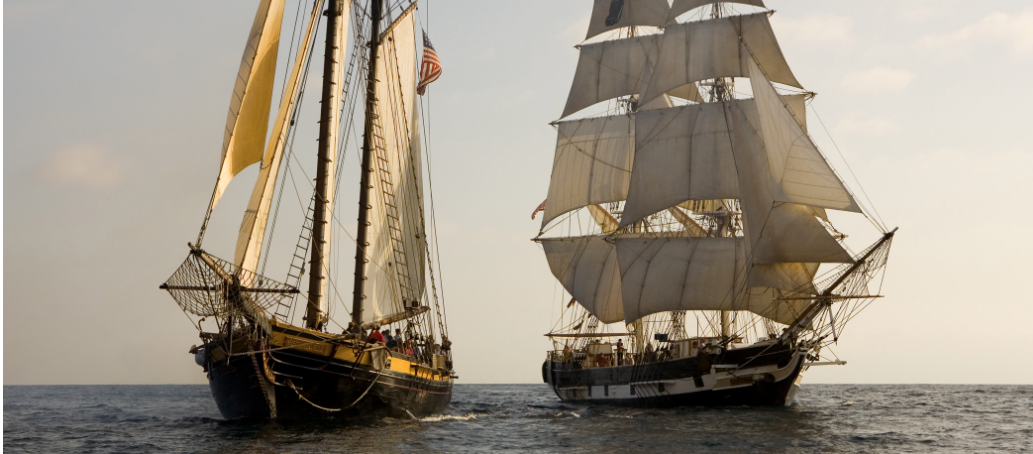
As long as humankind has sought to cross the oceans, we have employed the principles of wind and fluid dynamics without formally understanding the physics behind them. Tall ships represent one of history’s most sophisticated applications of physics, evolving from trial and error into a precise engineering discipline. Long before the formalization of classical mechanics, early shipwrights and mariners observed how forces interacted with the ships they built.
In the early days of sailing, vessels were equipped with little more than a giant piece of cloth stretched across a pole and attached to a mast precariously fastened to the ship. These simple sails captured the wind effectively, but only allowed ships to travel in the same direction as the wind. Over time, however, square-rigged ships evolved as sailors learned to manipulate sails in ways that allowed vessels to travel in almost any direction relative to the wind.
As the Golden Age of Sail reached its peak in the 19th century, shipbuilding became a more refined science, driven by the demand for faster and more efficient vessels capable of meeting growing commercial pressures. Engineers applied principles of fluid dynamics, including those described by Bernoulli, to design hulls optimized for speed and efficiency. These magnificent ships, with their acres of canvas and masts towering hundreds of feet above the sea, were ultimately limited only by the strength of the materials from which they were built. As stronger alloys were developed, ships continued to grow in size.
As long as humankind has sought to cross the oceans, we have employed the principles of wind and fluid dynamics without formally understanding the physics behind them. Tall ships represent one of history’s most sophisticated applications of physics, evolving from trial and error into a precise engineering discipline. Long before the formalization of classical mechanics, early shipwrights and mariners observed how forces interacted with the ships they built.
In the early days of sailing, vessels were equipped with little more than a giant piece of cloth stretched across a pole and attached to a mast precariously fastened to the ship. These simple sails captured the wind effectively, but only allowed ships to travel in the same direction as the wind. Over time, however, square-rigged ships evolved as sailors learned to manipulate sails in ways that allowed vessels to travel in almost any direction relative to the wind.
As the Golden Age of Sail reached its peak in the 19th century, shipbuilding became a more refined science, driven by the demand for faster and more efficient vessels capable of meeting growing commercial pressures. Engineers applied principles of fluid dynamics, including those described by Bernoulli, to design hulls optimized for speed and efficiency. These magnificent ships, with their acres of canvas and masts towering hundreds of feet above the sea, were ultimately limited only by the strength of the materials from which they were built. As stronger alloys were developed, ships continued to grow in size.